Top Tax Mistakes First-Time Homebuyers Make (and How to Avoid Them)
Anúncios
Purchasing a home for the first time is an exciting milestone, filled with a mixture of emotions and financial decisions. However, amidst the thrill of signing contracts and envisioning new beginnings, many first-time homebuyers underestimate the complexities of tax implications related to homeownership. Tax mistakes can lead to unexpected expenses, reduced financial benefits, or compliance issues with the IRS. Understanding these pitfalls upfront not only helps in maximizing tax advantages but also safeguards your investment over the long term.
In 2023, first-time homebuyers comprised approximately 35% of the U.S. housing market according to the National Association of Realtors (NAR). Yet, studies show many of them miss out on critical tax benefits or make costly errors during tax filing season. For example, a 2022 survey by TurboTax reported that 29% of first-time homebuyers were unsure about which home-related expenses qualified for deductions or credits. This article outlines the top tax mistakes first-time homebuyers make and practical strategies to avoid them, backed by real cases, data, and comparative insights.
Overlooking the Mortgage Interest Deduction Eligibility
Anúncios
One of the most celebrated tax benefits for homeowners is the mortgage interest deduction (MID). Many first-time buyers assume that all mortgage interest paid during the year is deductible, but this is not always the case. The IRS restricts the deduction to interest on mortgage debt up to certain limits, depending on when the mortgage was originated. For single filers or joint filers who took the mortgage after December 15, 2017, the limit is $750,000 ($375,000 for married filing separately). Mortgages taken out before that date have a higher limit of $1 million.

Anúncios
A young couple reviewing mortgage documents and tax forms at a kitchen table, highlighting the concept of mortgage interest deduction limits and tax planning for first-time homebuyers.
Consider the case of John and Maria, first-time homebuyers from Chicago, who purchased their home in 2023 with a mortgage balance of $900,000. They assumed the entire mortgage interest would be deductible. However, during tax preparation, they learned that only the interest on the first $750,000 was deductible, and the portion on the additional $150,000 was not. Consequently, their expected tax savings dropped by nearly 15%. This often-overlooked detail underscores the need to carefully review mortgage terms and IRS limits before claiming deductions.
Moreover, another frequent mistake is failing to itemize deductions to claim mortgage interest. Homeowners who opt for the standard deduction may miss out. For 2023, the standard deduction is $13,850 for single filers and $27,700 for married couples filing jointly, which sometimes exceeds the potential itemized deductions. However, taxpayers with significant mortgage interest and property tax payments generally benefit from itemizing. Using tax software or consulting a tax professional can help determine the best approach.
| Aspect | Standard Deduction (2023) | Itemized Mortgage Interest | Benefit Scenarios |
|---|---|---|---|
| Single Filer | $13,850 | Typically higher for mortgages above $200K | High mortgage interest payers |
| Married Filing Jointly | $27,700 | Usually beneficial for mortgages >$300K | Homeowners paying substantial interest |
| First-Time Homebuyers’ Typical Mortgage | $250,000 – $400,000 | Often beneficial if combined with property taxes | Depends on total deductible expenses |
Misunderstanding Property Tax Deductibility Limits
Property taxes are another deductible expense for homeowners, but recent tax reforms require caution. The Tax Cuts and Jobs Act (TCJA) of 2017 capped state and local tax (SALT) deductions, which include property taxes, at $10,000. This cap applies to the combined total of state income, local income, and property taxes for each tax return.
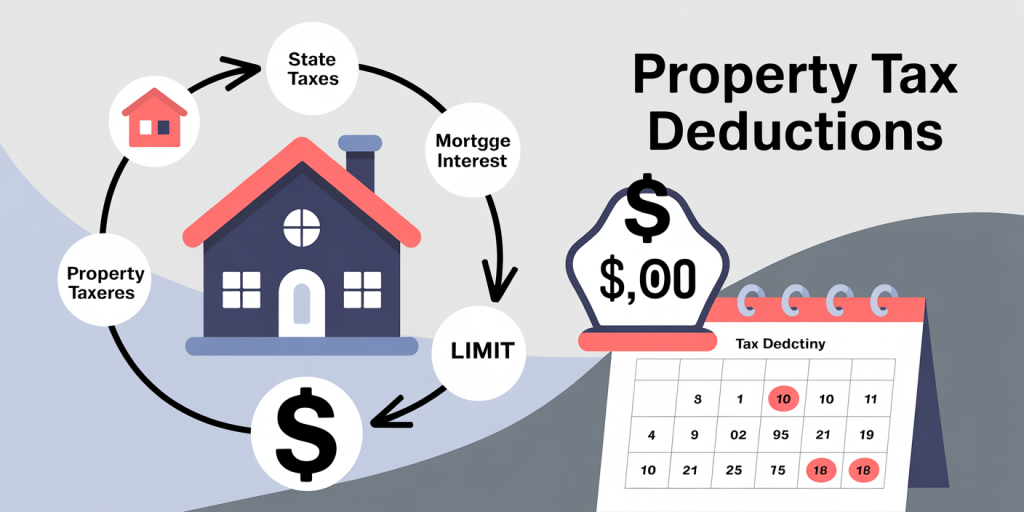
An illustrated infographic showing property tax deductions with a cap symbol representing the SALT $10,000 limit, including home icons, state tax symbols, and a calendar indicating recent tax reforms.
Consider Erica, a first-time homebuyer in California, where property taxes can be 1.1% of home values, combined with high state income taxes. Her annual property tax bill was $15,000, but due to the SALT cap, she could only deduct $10,000, limiting her tax savings. Misunderstanding this cap leads some buyers to overestimate tax benefits, resulting in inflated budgets and unexpected tax liabilities.
Smart planning includes reviewing SALT deductions in the context of total tax burden and exploring alternatives such as tax credits or deduction strategies at the state level. In some states, first-time buyers have access to local tax relief or rebate programs that may alleviate burdens beyond federal deductions.
Neglecting the Impact of First-Time Homebuyer Credits and Programs
Tax credits specifically designed for first-time homebuyers can be valuable yet are periodically available based on legislation and state programs. The original federal first-time homebuyer tax credit, widely publicized during the housing crisis (2008-2010), is no longer available at the federal level but persists in various forms at the state level.
Federal credits are different from deductions: credits reduce tax liability dollar-for-dollar, while deductions only reduce taxable income. Not leveraging current or regional credits is a missed opportunity. For example, the Massachusetts Residential Incentive Program offers up to $3,000 in credits for eligible multigenerational first-time buyers.
In 2022, a first-time buyer in Texas took advantage of the State’s My First Texas Home Program, which offered mortgage credits and down payment assistance enhancing their tax position. Conversely, many unaware homebuyers fail to explore these programs, losing out on thousands in savings.
Homebuyers should also monitor local governments’ offerings frequently updated based on housing market goals. Connecting with real estate agents and tax advisory professionals familiar with these programs ensures eligibility and compliance.
Incorrectly Reporting Home Sales and Gains
While the focus is usually on buying, how you handle taxes when selling a home is equally important. The IRS allows homeowners to exclude up to $250,000 of capital gains ($500,000 for married couples filing jointly) from the sale of a primary residence, provided certain conditions are met: ownership and use of the home for at least two of the last five years.
First-time sellers often erroneously report the entire sale or overlook eligibility criteria, leading to unnecessary capital gains taxes. For instance, Samantha bought her first home in 2020 but relocated for work within 18 months. When she sold her home, she faced capital gains taxes because she didn’t meet the two-year ownership and use requirement. Proper understanding of exclusion rules and timelines is key.

A visual comparison chart depicting the capital gains tax exclusion for home sales, featuring two scenarios of first-time home sellers with annotated numbers for purchase price, sale price, exclusion applied, and taxable gain.
Additionally, homeowners should keep detailed records of home improvements that increase the home’s basis and reduce capital gains liability. Renovations such as kitchen upgrades, new roofing, or additions can be added to the cost basis, reducing taxable gains when selling.
Here is a comparative table illustrating the impact of capital gains exclusions on two hypothetical first-time homeowners:
| Scenario | Home Purchase Price | Sale Price | Capital Gains | Exclusion Applied | Taxable Gain |
|---|---|---|---|---|---|
| Meets 2-year ownership/use requirement | $300,000 | $400,000 | $100,000 | $250,000 | $0 |
| Does not meet requirement | $300,000 | $400,000 | $100,000 | $0 | $100,000 |
Failing to Understand the Tax Implications of Home Equity Loans and Refinancing
Many new owners are unaware that home equity loans and refinancing carry specific tax consequences. Interest on home equity debt is only deductible if the loan proceeds are used to buy, build, or substantially improve the home securing the loan under current tax laws. Using the funds for personal expenses like vacations or credit card debt does not qualify for deductions.
A recent case in Florida saw a first-time homeowner take a $50,000 home equity loan for a vacation trip, later deducting the interest on their tax return. This prompted an IRS audit, leading to penalties and interest. Tax courts have consistently ruled that only home-related expenditures on equity debt qualify.
Refinancing an existing mortgage may produce deductible points (prepaid interest), but these must be amortized over the life of the loan rather than deducted entirely upfront, which can confuse first-time buyers. Understanding these nuances is essential to avoid misclaiming deductions and triggering audits.
Future Perspectives on Tax Planning for Homebuyers
Looking ahead, tax policies related to homeownership continually evolve in response to economic factors and government initiatives. The current trend indicates a push towards simplifying deductions and possibly increasing incentives for affordable housing development. For example, proposals in 2024 suggest expanding first-time homebuyer credits to stimulate market activity and support modest-income buyers.
Digital advancements in tax preparation software increasingly incorporate built-in guidance specifically for homeowners, reducing the likelihood of errors. Moreover, big data and AI tools offer personalized tax planning strategies, enabling first-time buyers to optimize savings during purchase, ownership, and sale phases.
Sustainability trends are also shaping tax incentives, with growing credits for energy-efficient home improvements and “green” mortgages. Buyers investing in solar panels or electric vehicle chargers may see increasing opportunities for tax relief in the coming years.
Staying informed about evolving regulations and leveraging expert advice will become crucial for first-time homebuyers. Proactive tax planning—from purchase negotiations to record keeping—will empower owners to maximize financial benefits and minimize risks associated with tax mistakes.
Purchasing a home is one of the most significant financial decisions many make, and understanding the tax landscape is vital to protecting and enhancing that investment. Avoiding common mistakes related to mortgage interest deductions, property taxes, credits, home sale gains, and equity loans can save substantial amounts and prevent legal complications. With careful planning, ongoing education, and professional guidance, first-time homebuyers can confidently navigate tax complexities and secure a successful path to homeownership.


Post Comment