How to Legally Reduce Your Taxable Income With Smart Investing
Anúncios
Navigating the maze of taxes is an inevitable part of financial life, but astute investors know that the key lies not just in earning wealth but in managing how much the government claims from it. Smart investing provides a legal and effective way to reduce your taxable income, allowing your assets to grow more efficiently while keeping more of your money in your pocket. Through strategic allocations, use of tax-advantaged accounts, and thoughtful timing of gains and losses, investors can significantly optimize their tax burdens.
In this article, we will explore proven methods and investment vehicles that help legally reduce taxable income. Offering practical examples, comparative analysis, and insights drawn from real-world cases, this guide is designed to empower investors—from beginners to seasoned professionals—to implement tax-saving strategies prudently within the boundaries of current law.
Why Reducing Taxable Income Matters for Investors
Anúncios
Taxes can erode investment returns substantially. According to a 2023 report by the Congressional Budget Office, the average effective tax rate for capital gains in the US stands at approximately 15%, while ordinary income tax rates can reach up to 37% at the highest brackets. Over time, these taxes compound, significantly lowering net investment outcomes. For example, an investment yielding 8% annually may, after taxes, return closer to 6.5%-7%, depending on the investor’s bracket and the nature of the income.
Reducing taxable income helps investors retain more capital to reinvest, accelerating wealth accumulation. Additionally, minimizing tax liability nestles within a holistic approach to financial planning, balancing risk, return, and liquidity while respecting regulatory frameworks. In practice, legally reducing taxable income is largely about leveraging specific investment accounts, choosing the right assets, and timing transactions to maximize tax benefits.
Anúncios
Using Tax-Advantaged Accounts to Shield Income
One of the most straightforward ways to reduce taxable income is by investing through tax-advantaged accounts. These accounts either defer taxes on earnings or exempt them entirely, allowing investments to grow without immediate tax consequences.
Retirement Accounts (401(k), IRA, Roth IRA): Contributions to traditional 401(k) plans reduce taxable income in the year they are made. For instance, if you earn $80,000 annually and contribute $15,000 to your 401(k), your taxable income for that year could effectively drop to $65,000, potentially moving you into a lower income tax bracket. Earnings within the 401(k) grow tax-deferred, and taxes are paid only upon withdrawal, typically at retirement.
In contrast, Roth IRAs require contributions with after-tax income but allow tax-free growth and withdrawals. While this does not reduce taxable income upfront, it is highly advantageous for long-term tax planning and shielding future income from tax. A 2022 study by the Employee Benefit Research Institute indicated that 56% of Americans approaching retirement were utilizing Roth accounts to diversify their tax exposure during retirement.
Health Savings Accounts (HSA): For individuals with high-deductible health plans, contributing to an HSA provides triple tax benefits: contributions reduce taxable income, gains within the account are tax-free, and withdrawals for qualified medical expenses are tax-exempt. According to the IRS, in 2024, individuals can contribute up to $3,900 to an HSA, and families up to $7,750.
Comparative Table: Tax Advantages of Common Investment Accounts
| Account Type | Tax Deferral | Tax-Free Growth | Contribution Tax Deduction | Withdrawal Taxation | Contribution Limits 2024 (USD) |
|---|---|---|---|---|---|
| Traditional 401(k) | Yes | Yes | Yes | Taxed as ordinary income | $22,500 ($30,000 if 50+) |
| Roth IRA | No | Yes | No | Tax-free | $7,000 ($8,000 if 50+) |
| Traditional IRA | Yes | Yes | Usually yes | Taxed as ordinary income | $7,000 ($8,000 if 50+) |
| Health Savings Account (HSA) | Yes | Yes | Yes | Tax-free if qualified | $3,900 individual, $7,750 family |
By strategically maxing out contributions to these accounts early in the year, investors can effectively lower their taxable income and protect their wealth from immediate tax liabilities.
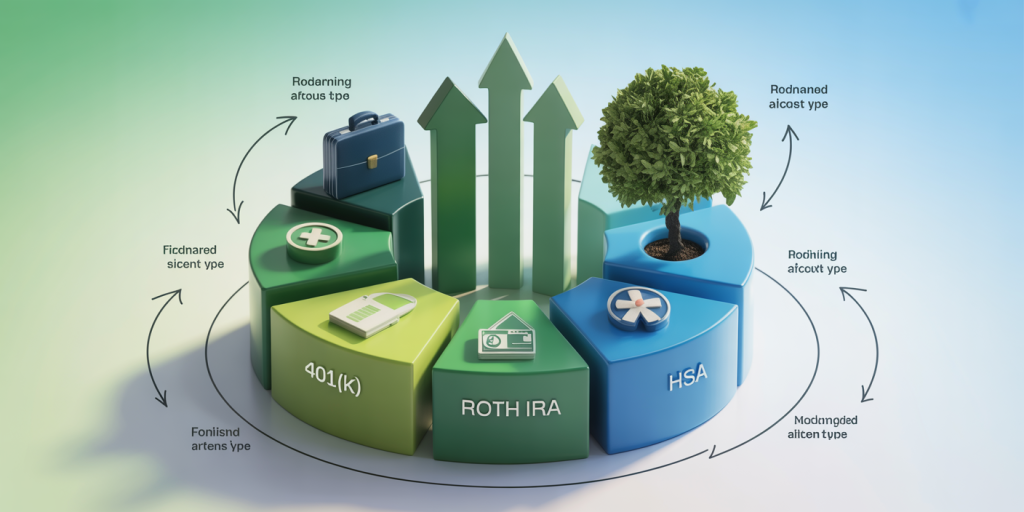
Illustration of diverse tax-advantaged investment accounts (401(k), Roth IRA, HSA) showing money growth shielded from taxes, with clear graphics of tax savings and account types.
Investing in Municipal Bonds for Tax-Exempt Income
Municipal bonds (munis) present a unique investment opportunity by offering interest income that is often exempt from federal income taxes and, in some cases, state and local taxes. This tax-exempt status makes municipal bonds particularly attractive for investors in higher tax brackets seeking regular income without corresponding tax burdens.
For example, a 2023 report from the Municipal Securities Rulemaking Board (MSRB) highlighted that the average yield of AAA-rated municipal bonds hovered around 3.3%, compared to 4.5% on comparable taxable corporate bonds. However, when adjusted for taxes, the after-tax yield on municipal bonds for investors in the 35% federal tax bracket can surpass the corporate bond yields. Mathematically, a $1,000 municipal bond paying 3.3% equals $33 in tax-free interest per year. A taxable bond would need to pay nearly 5.1% to yield the same after-tax income for someone paying 35% in taxes:
\[ Taxable \ Yield \times (1 – 0.35) = 3.3\% \Rightarrow Taxable\ Yield = \frac{3.3\%}{0.65} \approx 5.1\% \]
Practical Case: Jane, a high-earning professional in California with a state income tax of roughly 9.3%, buys $50,000 in muni bonds. Her tax-equivalent yields are even more attractive due to combined federal and state tax exemptions. By allocating 20% of her portfolio to munis, Jane increases after-tax income while legally reducing taxable income derived from taxable bonds or dividend-paying stocks.
Investors should note, however, that while municipal bonds reduce taxable income, they come with risks like interest rate risk and credit risk. Proper diversification and bond laddering can mitigate such risks.

Visual comparison of municipal bonds versus taxable bonds highlighting tax-exempt interest income, including a professional investor analyzing tax benefits and portfolio diversification.
Utilizing Tax-Loss Harvesting to Offset Gains
Another powerful strategy for legally reducing taxable income is tax-loss harvesting. This technique involves selling investments at a loss to offset capital gains realized elsewhere in the portfolio, thereby lowering overall taxable income.
For instance, if an investor realizes $10,000 in capital gains from stock sales during the year but also incurs $7,000 in losses from other sales, the net taxable capital gain would be $3,000. If losses exceed gains, up to $3,000 of net losses can be deducted against ordinary income each year, with additional losses carried forward to future tax years.
Real Case: The Journal of Financial Planning (2022) published a case study of a portfolio manager working with clients to systematically implement tax-loss harvesting. Clients achieved an average tax savings of approximately $1,500 annually on gains ranging $10,000–$20,000 per year, which compounded to notable increases in after-tax returns over a decade.
To execute tax-loss harvesting without violating IRS wash-sale rules (which prevent repurchasing identical securities within 30 days), investors often buy similar but not “substantially identical” securities to maintain market exposure. Common substitutions include investing in ETFs or mutual funds with marginally different compositions or sector focuses.

Conceptual image of tax-loss harvesting strategy: investor balancing gains and losses with charts, calendar marking 30-day wash-sale rule, and buying similar but different securities to optimize taxes.
How Real Estate Investing Can Lower Taxable Income
Real estate offers additional avenues to reduce taxable income through deductions and depreciation. Investors can deduct mortgage interest, property taxes, and operational expenses from rental property income. Moreover, depreciation—a non-cash expense based on the IRS’s allowable lifespan for property—can significantly reduce taxable rental income.
For example, if you own a residential rental property worth $300,000 (excluding land), you can typically depreciate the building over 27.5 years. This creates an annual depreciation deduction of about $10,909, which can offset rental income and reduce overall taxable income.
Case Example: Carlos owns two rental units generating $30,000 in gross rental income annually. After deducting mortgage interest, property taxes, maintenance, and $21,800 in combined depreciations, his taxable rental income drops to near zero, minimizing tax liability.
Additionally, the IRS permits deferral of capital gains taxes on real estate via a 1031 exchange, allowing investors to reinvest proceeds into a “like-kind” property without immediate tax consequences, thereby preserving capital for future growth.
Future Perspectives: The Evolution of Tax-Efficient Investing
The landscape of taxation and investing continues to evolve, shaped by policy changes, market conditions, and technology. For example, proposals to increase capital gains taxes, adjust contribution limits to tax-advantaged accounts, or alter deductions could impact the effectiveness of current strategies.
Simultaneously, advances in algorithm-driven portfolio management and fintech platforms enable investors to automate tax-loss harvesting and optimize asset location (placing tax-efficient investments in taxable accounts and tax-inefficient in tax-deferred accounts). Robo-advisors, for example, have consistently outperformed manual taxation management in reducing taxable incidents as per a 2023 study by Morningstar.
Environmental, Social, and Governance (ESG) investing is another frontier, as governments consider tax incentives for investments that promote sustainability. This could open new pathways for tax-efficient investing aligned with ethical and financial goals.
On the horizon, more sophisticated strategies combining tax deferral, estate planning, and asset transfer will become accessible to a broader range of investors. Staying informed through reliable resources and consulting tax professionals remain critical to adapting effectively.
By understanding and employing these techniques—maximizing tax-advantaged accounts, incorporating municipal bonds, leveraging tax-loss harvesting, and investing in real estate—investors can legally and smartly reduce their taxable income. With discipline and strategic foresight, tax planning becomes an integral part of wealth-building, empowering you to retain more earnings and capitalize on growth opportunities.



Post Comment